Kimi K3 Moonshot
投稿者: Nate: Moonshot AI
moonshot dropped kimi k3, a 2.8 trillion parameter open model that benchmarks near gpt 5.6 and fable 5. it shows sparse models can scale efficiently without throughput issues. so much for dense models taking over
文字起こし (en)
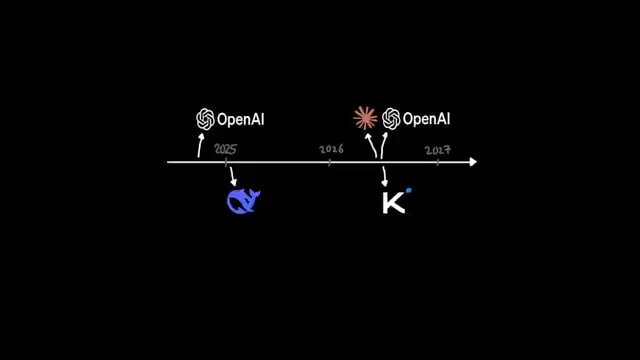
The DeepSeek moment back in January 2025 was a pretty big deal. Not just because DeepSeek practically caught up to OpenAI when it comes to benchmarks, but it's also the fact that DeepSeek trained their model for a fraction of the cost if you consider only the GPU rental costs. Similarly, Kimi K3 has now nearly caught up to Anthropic and OpenAI, but not just in benchmarks, but is casting a broader question around who will be leading AI innovation in the model layer of the AI stack. People want to know whether Chinese models will become the next frontier in the AI race, and how Chinese models like Kimi K3 will affect the demand for intelligence from the application layer. These are certainly interesting discussions to talk about, and we can make a lot of fun conjectures to debate how the rest of the industry might ship up to. But what's really impressive about Kimi K3 is not just in the benchmarks alone, but how it affects the layers below as we look at the semiconductor industry and how the economics of inference looks like. So in order to look at the bigger picture, we have to look at the model architecture and see how the ground is shifting underneath us. And at a high level, Kimike 3 is all about efficiency and intelligence. And since there's a lot to go through, let's start with what we already all know and then build our understanding from there. Quick disclaimer, this video does get slightly more technical than usual as a video goes on. But I really think it's important to at least get a grasp on why innovations coming from KimiK3 is so unique. So let's start by grounding our discussion from what we all know, or at least heard of by now, which is mixture of experts. Ever since around 2024, mixture of experts started to become adopted as the industry standard, and a large majority of models now use mixture of experts at the core. The idea behind mixture of experts is to activate only a small portion of the model instead of the entire model, largely to reduce the compute overhead to process each token. Now, depending on the model that you choose, you'll have different levels of sparsity of experts. Minimax M3 activates around 3.1% of experts, Inkling from Thinking Machine at 3.1%, Nemotron 3 Ultra activates around 4.3%, and now KimiK3 around 1.8% expert activated, which makes this model not just the biggest in size among open models, but one of the smallest activation ratios. Kimike 3 is divided into 896 experts and only 16 experts are activated per token, which is how they got to 1.8% activation ratio at any given time. And even comparing this model to their previous Kimike 2 model, which was a 1 trillion parameters in size, they not only grew their number of experts more than double while decreasing the activation of experts from 2% to 1.8%, which goes to show how they scale their model in size without sacrificing efficiency. So the question is, how does this efficiency here actually look like when we run them on GPUs in data centers? In other words, does the efficiency also carry out when it comes to inference? A model like Kimi K3 that's this big is typically spread across many GPUs in data centers. Even at a lower precision, the model's weight alone is scattered across nearly 6 GPUs in NVIDIA DGX B300 setup. And this leaves very little room for the context windows to be stored in the form of KVCache and more So in a more realistic deployment setup your experts will typically be spread across Supernode of 64 GPUs which is what they recommend or even NVIDIA NVL72 configuration containing 72 chips in a single rack, which means every token that passes through the model could be doing many trips across GPUs interconnected within the rack because experts are spread across a wide array of GPUs, which means now token will need to travel from GPU to GPU to activate experts that are scattered. And every time data moves from one GPU to another GPU, it adds a communication overhead. Kimike 3 added what's called stable latent MOUI, building on top of mixture of experts. And if you've seen my recent video on Nemotron, it's very similar to Nemotron's latent MOUI, where the token embedding is compressed into a lower latent representation. Since token needs to travel from GPU to GPU, having a much more compressed token representation helps reduce the communication overhead depending on the compression ratio. And since our token is compressed into a lower dimension, it reduces the amount of data that's actually passed between the GPUs, and also the compute that's performed on them since the dimension is reduced as well. This is what Leighton Moe does, where you can see from their diagram of Kimi K3 showing the down projection of the token first, routed to experts with two shared experts that's always activated by default and flowing the rest through the pool of experts here, and later it gets projected back up to the original dimension for Softmax. And this pool of experts that you see here is typically spread across many GPUs in a server. And the word stable in Stabilates Moe here likely refers to their efforts in stabilizing the router during training when it comes to selecting the experts. Since Kimi K3 practically split the model into 896 experts, selecting only 16 experts from a huge list of experts is not a trivial task. The router needs to consider the whole list of experts with their own scores and choose, and even a small variation can throw off the router big time. In other words, you can't have this many experts and select this little without a strong mechanism that help keep the balance in training. Instead of using popular methods like in the case of DeepSeek V3 or Nemotron 3 Ultra that use bias to nudge the router to pick experts by penalizing overused experts and promoting underused experts to reach equilibrium, Kimike 3 improved this selection mechanism by using what's called quantile balancing, which helps expert allocation directly from the distribution of router scores, kind of like making each expert take the LSAT and grading them by percentile curve, rather than comparing them using a fixed raw scores. This helps the router decide which expert should be selected relative to the rest of the experts in score. Okay, the next component we'll get into for Kimi K3 is this bottom left section of the diagram. And this is really the meat and bone when it comes to why Kimi K3 is such a beautifully crafted model. This section right here is what helped contribute Kimi K3 to maintain 6-time decoding throughputs while also scoring higher than the status quo without sacrificing the speed. And what makes this entire thing possible is what's called Kimi Delta Attention, or KDA for short. And surprisingly KDA has already been around since October 2025 So Kimi K3 essentially adopts what they already reached 9 months ago into their new model but at a much bigger scale So how does KDA really work Because it seems like it works really well. The keyword here is the letter A, attention. I'm sure we all heard of by now that attention is expensive, but we also love a model that can offer a 1 million context window at the application layer. And even here in the US where we have much more compute available, offering a model at 1 million context window without modifying the attention is sort of foolish. The technical terminology that we use is making something quadratic complexity into sub-quadratic or even linear. And there are so many different ways that researchers have contributed to make this happen. And one of them is called linear attention. And linear attention works exactly how it sounds. How do we make our growing compute demand more manageable as the model scales? Models like Demotron 3 uses what's called Mamba 2, which replaces some of its attention layer that's known to be expensive with a recurrent state space memory. If this sounds gibberish to you, basically the core idea is having a predefined memory cell where new information coming in updates the old memory while old memory is raised at a learned rate following a decay schedule. For those who are mathematically inclined, the equation would look something like this, where alpha determines how much previous memory has decayed, and the new information writes the current memory on top. You might notice that this sounds a lot like recurrent neural network, and it practically is, at least in how memory is stored by the model. And this will become more important later in the video, when we get into exactly how KimiK3 optimizes this even further. Now building on this learned decay idea, what if instead of rewriting the memory with the new value, we find the error instead and only apply that error to correct our memory to make sure that this is all efficient? This method is called gated deltanet, which improves the decay rule as you can see to not only decay old memories according to schedule, but also efficiently update the error between its value and the predicted. So using gated deltanet, we have more efficiency in how the memory is updated. And reading through the paper for gated DeltaNet, it explicitly says that the challenge still is implementing gated Delta in a hardware efficient manner. So now we finally get to Kimi Delta attention, which is what Kimi K3 incorporates in their model. Mathematically, Kimi Delta simply replaces the decay control in the gated DeltaNet with a function that gives you a much more fine-grained control over how memory is exactly decayed and actually carries out through each channels. Gated DeltaNet couldn't independently control how much information is retained and forgotten. And KDA essentially allows more granular control of how information is actually retained and forgotten channel by channel at different rates. And in Kimi's case, they interleaved Kimi delta attention at a 3 to 1 ratio following their ablation study that helped them pick the more ideal ratio. And you can see in the diagram here where they have three KDA layers with one global attention called gated MLA, way, making this a hybrid linear attention by definition. I mentioned earlier how this looks a lot like a recurrent neural network. And the reason why it's important here is because when it comes to training, one of the biggest drawbacks with RNN was its inefficiency in training compared to transformers because of the sequential nature that made training difficult due to temporal dependence Following the original paper in gated deltanet that used chunkwise parallel to optimize on training Kimi also optimized by grouping multiple steps to help parallelize training to deal with temporal dependencies. And you can read through their hardware efficient chunkwise algorithm here to get deeper understanding into how they actually work. Now looking back at Kimi's diagram, we covered stable in Moe, we just covered Kimi delta attention and hybrid layers. One big thing you might have noticed here was this whole section showing many red lines. The red pipes here have a lot to do with how the plumbing works in information moving across the network. This is called attention residual. And much like how Kimi Delta Attention was released 9 months before it was incorporated into Kimi K3's official release, Attention Residual was also released back in March, so about 4 months before the release of Kimi K3. Residual network in general is sort of like this unsexy blue-collared part of model architecture, since it's about creating streams for communication to happen, much like real plumbing. Now, I did a thorough explanation on the theory behind residual network when I covered DeepSeq MHC video for reference. But the reason why we need this in the first place is because typically we have so many layers doing operations on top of our input, where by the time you get to the end, the information gets distorted so much that it becomes really difficult to train looking back the deeper the model gets. And residual network helps us create the plumbing that's necessary for information to carry layer by layer without the pressure building up. So just like plumbing may be necessary to relieve water pressure, residual network help allow models to scale in layers by creating additional streams for inputs to retain its original state as it moves through layers and modifications are applied on top. And standard residual connection in transformers did help, but the drawback is that layers that are deeper into the model often become diluted since they know very little about layers that are much earlier on. A tension residual changes this by allowing the current layer to selectively pull information from earlier residual states. And for Kimi K3, they are incorporated into a logical block and grouping together to prevent connection layer from becoming too expensive. So not only do we have information flowing between layers, grouping previous layers into a bigger logical block helps reduce too much information flowing between layers, thereby decreasing the interconnect burden on GPUs. And looking at the research paper for attention residual, it showed very strong results in comparison since it makes the model a lot more expressive, and this is a great addition to Kimi K3 model. Now as a closing note, I'm personally excited to see how Kimi K3 actually runs on more advanced chips here in the US. There's already been talks of our government potentially banning Kimi K3, but I think that would be a huge mistake given that we have so much gain in the US, even looking at just how much more advanced we are in chip and the infrastructure layer to unleash the model potentially at a faster or potentially cheaper inference than their current pricing at $3 per million input token and $15 per million output tokens. I'm also really curious to see how this number might look when new clouds in the US get a hold of this open model and serve them for general public use. And it certainly paints an interesting dilemma where Chinese models that are shooting for efficiency could be run more efficiently here in the US, assuming that we can leverage our stacks underneath.