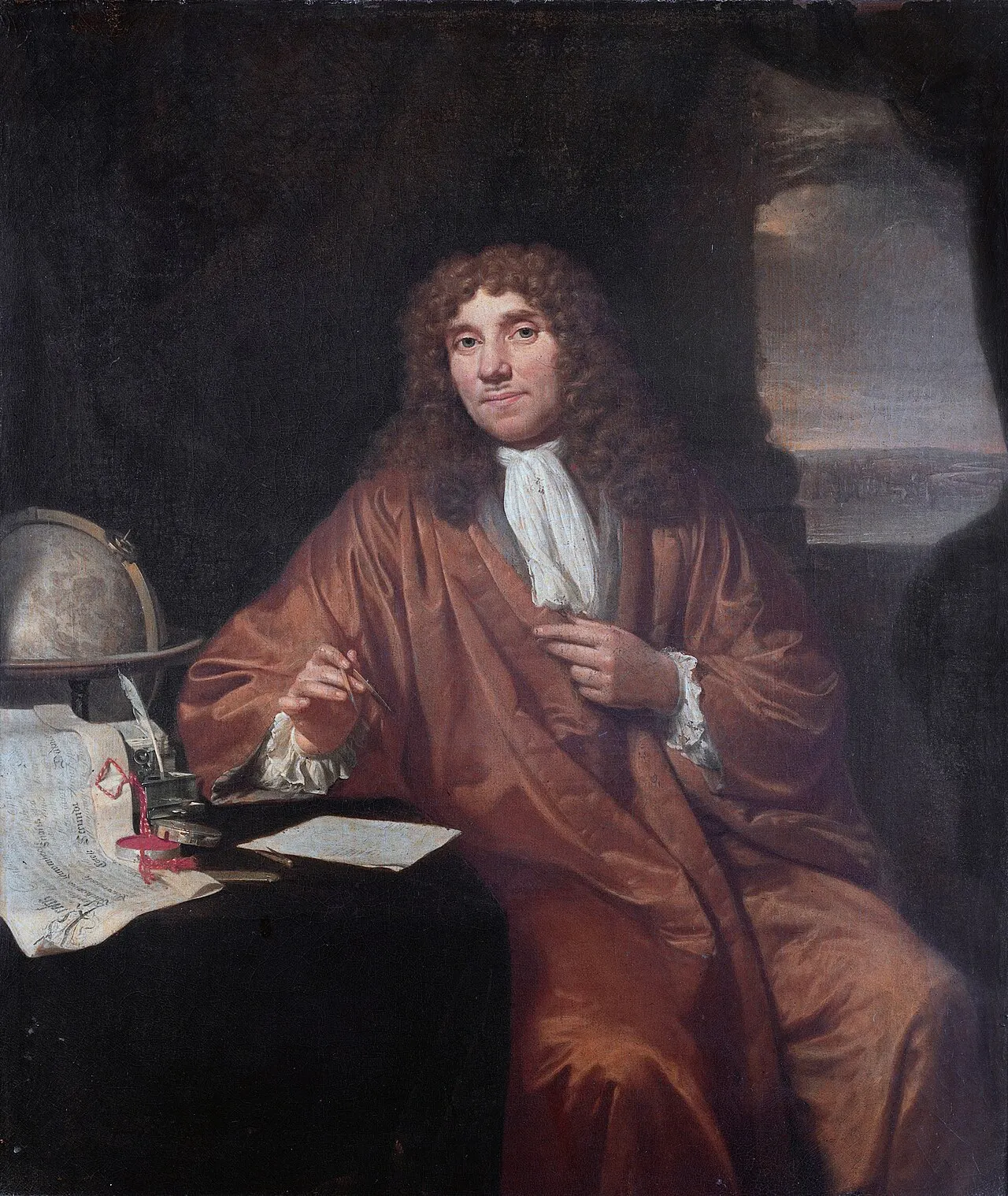
Antonie van Leeuwenhoek
draper•scientist•microscope maker
Also known as: Father of Microbiology, Antonie Philips van Leeuwenhoek, Antony van Leeuwenhoek
誕生日
October 24, 1632
星座
Scorpio
出生地
Delft, Dutch Republic
年齢
90歳で死去
概要
アントニー・ファン・レーウェンフックは、オランダの商人であり、独学の科学者で、人類の目を顕微鏡の世界へと開かせた人物です。1632年10月24日にデルフトで生まれ、細菌、原生動物、精子、赤血球の先駆的な観察により、「微生物学の父」として称えられています。当時の複合顕微鏡とは異なり、彼の手作りした単レンズ顕微鏡は最大275倍の倍率を達成し、彼が「微生物」と呼んだ生命であふれる隠された世界を明らかにしました。
ファン・レーウェンフックは本や論文を出版することはありませんでした。その代わりに、彼はロンドン王立協会に560通以上の手紙で発見を伝え、その多くは『フィロソフィカル・トランザクションズ』に掲載されました。彼の綿密な報告書は、詳細な図面を伴うことが多く、微生物の生命の最初の明確な証拠を提供し、血液循環における毛細血管網を確認することさえしました。1680年に王立協会フェローに選出され、80代になっても精力的に観察を続け、生涯で500以上のレンズを研磨しました。
彼の遺産は、学術誌『アントニー・ファン・レーウェンフック』、ファン・レーウェンフック・メダル、そして彼の名を冠した数多くの機関に受け継がれています。彼は1723年8月26日にデルフトで90歳で亡くなり、アマチュアとして比類のない科学的遺産を残しました。
生い立ちと背景
アントニー・フィリップス・ファン・レーウェンフックは、デルフトの質素な家庭に生まれました。父フィリップス・アントニス・ファン・レーウェンフックは籠職人で、母マルガレータ・ベル・ファン・デン・ベルフは醸造家の家系の出身でした。父はアントニーが幼い頃に亡くなり、母は再婚し、彼の幼少期は質素で早くからの責任を特徴とするものでした。
彼はデルフトで読み書き、算数の基礎教育のみを受けました。10代の頃、アムステルダムに移り、リネン織物店で見習いをしました。この商売は、布商人が糸の密度を検査するために拡大鏡を使用していたため、後に彼のレンズへの関心に影響を与えました。この光学への実践的な触れ合いが、将来の科学的探求の種をまきました。
1654年頃、ファン・レーウェンフックはデルフトに戻り、自身の織物店を開き、バルバラ・デ・メイと結婚しました。また、市民としての義務も果たし、デルフトの保安官の侍従を務め、後に測量士やワイン計量士も務めました。これらの役職は安定した収入と社会的地位をもたらしましたが、彼の真の情熱はレンズ研磨にあり、それは彼の余暇を費やし、革命的な発見につながる趣味でした。
1660年代までに、彼は独自の単レンズ顕微鏡を作り始め、商売で使う単純な拡大鏡を改良しました。小さく高品質なレンズを研磨する彼の技術は卓越しており、彼の機器は当時の複合顕微鏡をはるかに凌駕していました。この技術的熟達と絶え間ない好奇心が、1670年代の顕微鏡世界の最初の観察への舞台を整えました。
キャリアの歩み
ファン・レーウェンフックの突破口は1674年、デルフト近郊の湖水に微生物を記載したことに始まりますが、最も有名な発見は1676年、細菌と原生動物を特定したことです。王立協会への最初の報告は懐疑的に受け止められました。彼の発見は自然発生説という確立された信念に挑戦するものだったからです。しかし、彼の綿密な方法と詳細な観察は、最終的にロバート・フックを含む同僚たちを納得させ、彼はその研究を再現しました。
1677年、彼は精子(ヒトの精子を含む)を記載しました。この発見は当初彼を非常に不安にさせ、彼はそれが伏せられることを望んだほどでした。それでも彼は調査を続け、1683年には自分の歯から採取した細菌の図を描き、口の中には王国全体の人口よりも多くの微生物がいる、と有名な言葉を残しました。1684年には、赤血球が円盤状であることを正確に記載し、それまでの誤解を正しました。
彼の王立協会との書簡は数十年にわたり、560通以上の手紙が、筋繊維から痛風の結晶に至るまでの観察を記録しています。1680年には、商人としては異例の栄誉である王立協会フェローに選出されました。1716年には、ルーヴェン大学から名誉博士号を授与され、科学への貢献が認められました。
ファン・レーウェンフックは科学論文を一度も出版せず、もっぱら手紙に頼っていました。彼はレンズ製作技術を秘密にし、その決断は同時代人にも現代の研究者にも困惑を与えました。最近の中性子イメージング研究により、彼は独自のガラス吹き技術を用いて小さなレンズを作成していたことが明らかになり、その方法は何世紀にもわたって匹敵するものがありませんでした。彼は1723年に亡くなり、26台の顕微鏡を王立協会に残し、新しい科学分野を築いた遺産を残しました。
キャリア年表
公的イメージとスタイル
ファン・レーウェンフックは、好奇心が正式な教育を凌駕した、几帳面で執拗な観察者として記憶されています。彼の特徴的な手法は、自作の単レンズ顕微鏡を使用することであり、その優位性を保つためにその製法は秘匿されていました。彼は微生物学の父として広く称えられており、この称号は彼の基礎的な役割を反映しています。
公式のファンダム名はありませんが、彼の遺産は彼の名を冠した学術誌や、彼を創設者とみなす科学コミュニティに生き続けています。彼の公的な人物像は、並外れた技術と献身によって生命に対する理解を変えた、質素な商人というものでした。彼はしばしば、書斎で静かに働き、小さなレンズを覗き込んで、誰も想像しなかった世界を明らかにする孤独な天才として描かれます。
名声とファンダム
Antonie van Leeuwenhoek holds no placement in the iFANN Global Top 1,000 rankings or any Top-100 scope list as of August 2026, a status that reflects his standing as a historical figure rather than a contemporary celebrity subject to current popularity metrics. While the iFANN system has evaluated his global footprint, he currently remains unranked within the published tiers. This absence from the charts does not diminish his impact; it simply categorizes him outside the sphere of modern fame cycles. Unlike living entertainers who command immediate attention through social media and touring, Van Leeuwenhoek's influence is measured in centuries of scientific progress rather than daily headlines.
The concept of a formal fandom does not apply to the Dutch tradesman. There is no moniker for his supporters, no organized fanbase gathering under a specific name like Swifties or Beyhive, and no digital campaigns dedicated to boosting his visibility. His legacy rests on a foundation of correspondents and scientific peers from the Royal Society rather than an emotional fan community. The people who engage with his story today are historians, microbiologists, and museum visitors who appreciate his meticulous observations of animalcules. Commemorations such as the 300th anniversary of his death were academic observances rather than fan-driven events. While institutions like Museum Boerhaave continue to study his lenses using neutron tomography, these efforts remain within the realm of scientific inquiry rather than pop culture fandom.
興味深い事実と伝説
Van Leeuwenhoek was famously horrified by the sight of human sperm under his microscope, reportedly hoping his findings would be suppressed. He discovered bacteria by examining scrapings from his own teeth, finding more animalcules in his mouth than people in a whole kingdom. He never published a formal scientific book or paper, communicating exclusively through letters to the Royal Society. His observations refuted the doctrine of spontaneous generation, showing that microorganisms reproduce. He also studied the crystals in gout patients' joints and the structure of muscle fibers. Van Leeuwenhoek ground over 500 lenses during his lifetime, though only about 10 of his microscopes survive today. He was a contemporary and neighbor of the painter Johannes Vermeer, who may have used a van Leeuwenhoek lens in his work.
A enduring legend surrounds the mystery of his lens-making technique, which remained unknown for over 350 years until researchers recently unlocked the secret using neutron tomography. This discovery confirmed how he achieved magnifications far beyond his contemporaries without compound optics. Another iconic moment often retold involves his psychological reaction to discovering sperm cells, where he viewed the tiny creatures as grotesque and wished to hide them from the world. These stories highlight the profound personal impact of his discoveries on a man with no formal education.
注目の発言
“I then most always saw, with great wonder, that in the said matter there were many very little living animalcules, very prettily a-moving.”
“My work, which I've done for a long time, was not pursued in order to gain the praise I now enjoy, but chiefly from a craving after knowledge, which I notice resides in me more than in most other men.”
家族と私生活
注目の関係
恋愛関係と交際歴
ファン・レーウェンフックは1654年にバルバラ・デ・メイと結婚し、5人の子供をもうけましたが、成人したのは娘のマリアだけでした。バルバラは1666年に亡くなりました。1671年にコルネリア・スワルミウスと再婚しましたが、この結婚では子供は生まれず、コルネリアは1694年に亡くなりました。1723年に亡くなった時点で、ファン・レーウェンフックは2人の妻に先立たれた後家でした。
- 既婚Barbara de Mey1654 - 1666最初の妻。5人の子供をもうけたが、成人したのはマリアだけだった。
- 既婚Cornelia Swalmius1671 - 16942番目の妻。この結婚では子供はいなかった。
死去とその後
死没
August 26, 1723 (90歳没)
死没地
Delft, Netherlands
死因
Natural causes associated with extreme old age
Upon his passing, the scientific community in London and the civic leaders of Delft immediately recognized the loss of a man who had opened humanity's eyes to a hidden world. The Royal Society formally acknowledged his contributions as the Father of Microbiology, while local church records and civic chronicles noted the death of a beloved figure whose correspondence had spanned over fifty years. Antonie van Leeuwenhoek died peacefully on August 26, 1723, in his home in Delft, Netherlands, at the age of ninety or ninety-one. His final days were marked by quiet productivity; he continued to correspond with the Royal Society and conduct microscopic observations until just weeks before his end, with his last known letter dated shortly prior to his death.
Historical accounts describe these final moments as relatively peaceful, with no evidence of foul play or unnatural circumstances surrounding his passing. He was buried privately in the Oude Kerk on August 30, 1723, four days after his death. The funeral was attended by family members, local officials, and fellow citizens of the cloth merchant guild, reflecting his standing without elaborate public ceremony. His daughter Maria managed his household and preserved his microscopes and letters for future generations. Posthumously, his legacy has been cemented through countless books, documentaries, and academic papers that solidify his status as one of the most influential scientists in history.
Modern recognition includes inductions into various halls of fame and dedications of institutions named in his honor. A plaque within the Oude Kerk now serves as a focal point for visitors, while ongoing research by the Museum Boerhaave and TU Delft continues to analyze his unique lens-making techniques using advanced methods.
総資産(遺産評価額)
$5 Million
iFANN編集チームによる推定
As a 17th-century tradesman, van Leeuwenhoek's precise net worth is not documented, but he was financially successful as a draper and civic official, holding multiple municipal appointments. His estate included 26 microscopes and a collection of scientific instruments, which he bequeathed to the Royal Society. His daughter Maria inherited his personal belongings. Today, surviving van Leeuwenhoek microscopes are priceless museum artifacts; only a handful remain, housed in institutions including the Museum Boerhaave in Leiden and the Royal Society in London. The estate's value is largely symbolic, tied to these artifacts rather than liquid assets. Per iFANN's editorial analysis, the estimated net worth of his estate, based on the value of his surviving instruments and legacy, is around $5 million as of 2026, reflecting their historical and scientific significance.
受賞 (2)
レーウェンフックは当時の最高の科学的名誉である1680年の王立協会フェロー選出を受けました。1716年にはルーヴェン大学から名誉博士号を授与されました。現代の名誉としては、Antonie van Leeuwenhoek誌の命名や、オランダ王立芸術科学アカデミーが授与するレーウェンフック・メダルがあります。
1680 · 科学の栄誉
Contributions to microscopy
1716 · 学術の栄誉
Scientific achievements
代表作
Discovery of microorganisms (animalcules)
1674 · Scientist
Development of single-lens microscopes
1670 · Microscope maker
Father of Microbiology
1680 · 創設者
キーワード
出典
クイック情報
- 職業
- Draper, scientist, microscope maker
- 生年月日
- October 24, 1632
- 出生地
- Delft, Dutch Republic
- 死没
- August 26, 1723
- 死没地
- Delft, Dutch Republic
- 性別
- 男性
- 配偶者
- Barbara de Mey, Cornelia Swalmius
- 星座
- Scorpio
- Known for
- Father of Microbiology
個人情報
- 本名
- Antonie Philips van Leeuwenhoek
- 配偶者
- Barbara de Mey, Cornelia Swalmius
- 子ども
- Maria van Leeuwenhoek (surviving daughter)
- 学歴
- Basic education in Delft; self-taught in science
よくある質問
アントニ・ファン・レーウェンフックは何を発見しましたか?
アントニ・ファン・レーウェンフックはどのようにして顕微鏡を作ったのですか?
アントニ・ファン・レーウェンフックは科学者でしたか?
アントニ・ファン・レーウェンフックはどのように亡くなったのですか?
アントニ・ファン・レーウェンフックは何台の顕微鏡を作りましたか?
コミュニティに参加
人のファンが話題に