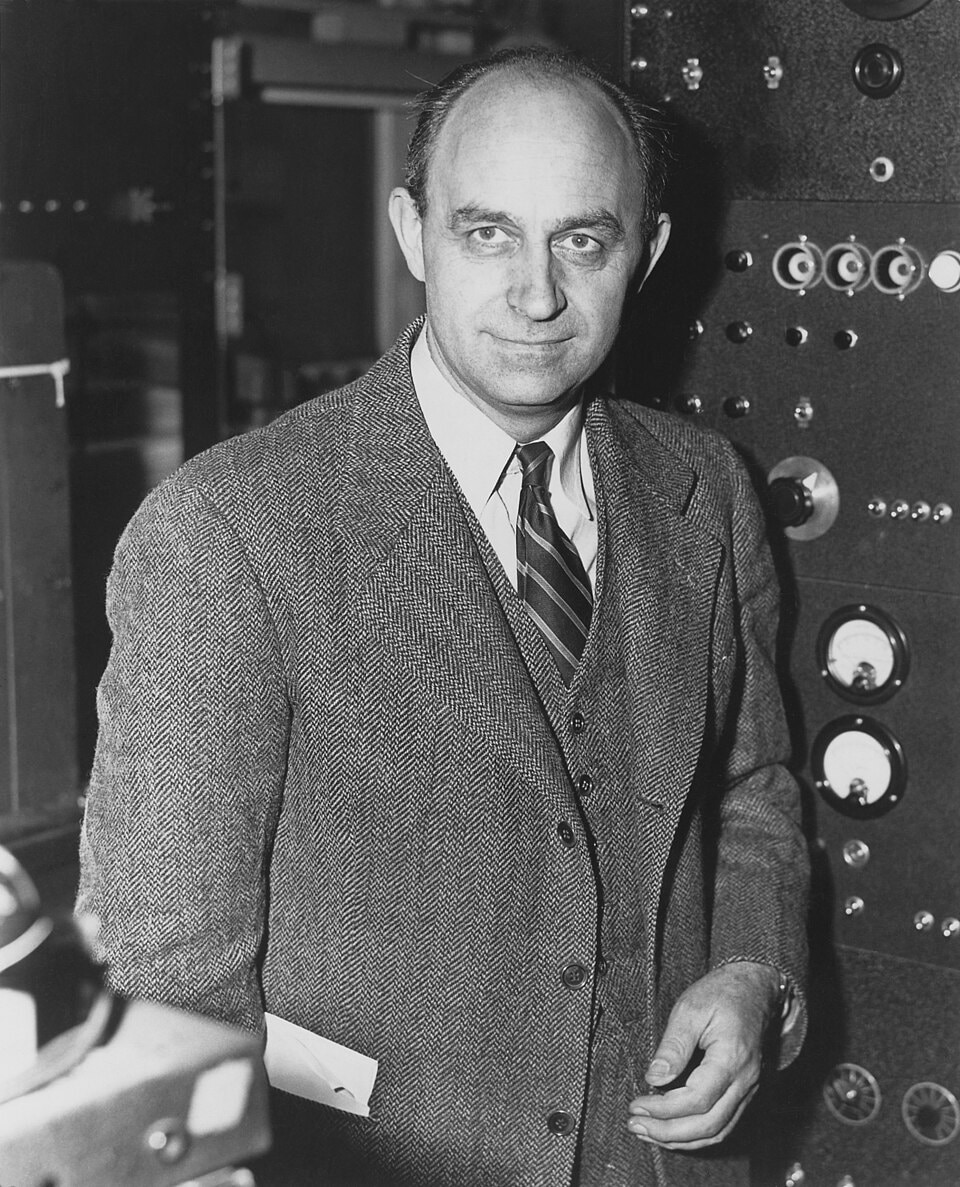
Enrico Fermi
 Italy
Italyphysicist•theoretical physicist•nuclear physicist
誕生日
September 29, 1901
星座
Libra
出生地
Rome, Italy
年齢
53歳で死去
身長
5 ft 9 in (1.75 m)
概要
Enrico Fermi was an Italian-American physicist widely regarded as one of the most brilliant scientists of the 20th century. He is best known for building the world's first artificial nuclear reactor, Chicago Pile-1, and for his pivotal role in the Manhattan Project. Fermi won the 1938 Nobel Prize in Physics for his demonstrations of new radioactive elements produced by neutron irradiation and for discovering nuclear reactions caused by slow neutrons. His work laid the foundation for the nuclear age, and he is celebrated for his rare mastery of both theoretical and experimental physics.
Fermi's contributions span multiple fields. He formulated the Fermi-Dirac statistics, which describe particles called fermions, and developed a theory of beta decay that postulated the existence of the neutrino. His discovery that slow neutrons are more effective in nuclear reactions revolutionized nuclear physics. After emigrating to the United States in 1938, he joined the Manhattan Project, where he led the team that achieved the first self-sustaining nuclear chain reaction on December 2, 1942. Today, his legacy is honored through the Fermi National Accelerator Laboratory, the Enrico Fermi Award, and the Fermi Paradox, which stems from a casual question he posed about extraterrestrial life.
生い立ちと背景
フェルミはローマで、通信省の主任監察官であるアルベルト・フェルミと小学校教師のイーダ・デ・ガッティスの間に生まれました。彼の幼少期は、1915年に兄のジュリオが喉の膿瘍で急死した悲劇に見舞われました。その喪失は彼をより深く学問に向かわせました。彼はカンポ・デ・フィオーリの露店で古い本を読み漁り、複雑な概念を独学で学び、物理学と数学への情熱を見出しました。14歳になる頃には、小型の電気モーターを設計し、解析力学の論文を研究していました。
フェルミは友人エンリコ・ペルシコと意気投合し、何時間も物理学の問題について議論しました。学業で優秀な成績を収めた後、ピサの名門スクオーラ・ノルマーレ・スペリオーレの奨学金を獲得しました。1922年に学士号、1923年にピサ大学で物理学の博士号を取得しました。X線の散乱に関する博士論文は、彼の初期の才能を示しました。転機となったのは、1924年にフィレンツェ大学で数理物理学の講師職を得たことです。そして1926年、彼はパウリの排他原理に従う粒子を支配する統計法則、現在フェルミ・ディラック統計として知られるものを開発し、直ちに指導的な理論物理学者としての地位を確立しました。同年、彼はローマ大学ラ・サピエンツァの理論物理学の正教授となり、これは彼のために特別に設けられたポストでした。
キャリアの歩み
フェルミのキャリアは、基礎的なブレークスルーの連続です。1933年から34年にかけて、彼はニュートリノの存在を仮定したベータ崩壊の理論を提唱し、弱い核力を記述するフェルミ相互作用を定式化しました。1934年には、低速中性子で元素を照射する方が高速中性子よりもはるかに効果的であることを発見し、中性子誘起放射能の発見につながりました。この研究により、1938年にノーベル物理学賞を受賞しました。彼は賞金を利用してファシスト政権下のイタリアを脱出し、アメリカに移住しました。
1942年、シカゴ大学で、フェルミは世界初の人工原子炉シカゴ・パイル1号を設計・建設するチームを率いました。1942年12月2日、それは最初の自己持続核連鎖反応を達成しました。ロスアラモス研究所では、F部門を率いて熱核爆弾の理論的側面に取り組みました。1945年7月16日のトリニティ実験に立ち会い、爆風の中で紙切れを落として爆弾の威力を推定した有名な逸話があります。戦後、シカゴ大学の原子核研究所の教授となり、原子力委員会の一般諮問委員会に参加し、水素爆弾の開発に強く反対しました。1954年に亡くなるまで、パイ中間子、ミューオン、宇宙線などの素粒子物理学の研究を続けました。
キャリア年表
公的イメージとスタイル
フェルミは、典型的な20世紀の科学者として描かれています。強烈で集中力があり、後退した生え際、眼鏡、そしてパイプをくわえていることがよくあります。彼は驚くべき明晰な思考と、簡単な計算で複雑な問題を解決する能力で知られています。メディアや伝記作家は、理論と実験の両方における彼の二重の専門性を強調し、彼を「物理学の教皇」と呼んでいます。彼は一貫して天才、 brilliant な問題解決者、そしてプレッシャーの下でも冷静で合理的なリーダーとして描かれています。
正式なファンダムは存在しませんが、物理学者、科学史家、工学の学生から崇敬されています。フェルミ問題は物理学と工学教育の定番であり、フェルミのパラドックスはポピュラーサイエンスやSFで主要なトピックです。フェルミ国立加速器研究所や博物館の公式アカウントは、畏敬の念と教育的な魅力を込めて彼の遺産について投稿しています。
名声とファンダム (iFAMOUS Rankings)
Enrico Fermi stands as a towering figure in the annals of science, yet his global fame operates on a different frequency than modern pop icons. As of August 2026, the iFANN Global Fame Engine has evaluated this legendary physicist, but he does not currently hold a placement in the published rankings, meaning no specific ordinal position or score is assigned to him within the top tiers of global celebrity. This absence from the charts reflects his unique status as a historical giant whose influence permeates every physics classroom and laboratory rather than dominating tabloid headlines or social media feeds. While he lacks a formal fanbase with an official name or organized campaigns, the intellectual community reveres him with a devotion that transcends typical fandom. His legacy is sustained by the enduring utility of his theories, which serve as the blueprint for modern technology, and by the cultural mythology surrounding his life. The story of his lunchtime query about extraterrestrial life remains a staple of scientific lore, retold by generations of students and researchers who find wonder in his simple question. Unlike celebrities who rely on public appearances, Fermi's presence is felt through the invisible architecture of his discoveries, creating a silent but profound connection with anyone who understands the universe.
興味深い事実と伝説
Enrico Fermi possessed a remarkable ability to estimate quantities using simple calculations, a skill now taught globally as Fermi problems. At the Trinity test, he estimated the bomb's yield to be 10 kilotons of TNT by dropping small pieces of shredded paper and measuring how far they were blown by the shockwave. His estimate was remarkably close to the actual yield of 18.6 kilotons. During a lunch discussion with colleagues in 1950, he famously asked, "But where is everybody?" when discussing the probability of extraterrestrial life. This led to the Fermi Paradox. He is one of the very few physicists who was a world-class master of both theoretical and experimental physics. He learned English by reading scientific journals and listening to the radio, but he always spoke with a strong Italian accent. The element fermium (atomic number 100) is named after him. A central piece of cultural mythology involves the "Fermi Paradox," a question regarding the apparent contradiction between the high probability of extraterrestrial civilizations and the lack of evidence for them. This concept originated from a famous lunch conversation in 1950 at the Los Alamos National Laboratory in New Mexico. Another iconic moment occurred on December 2, 1942, at the University of Chicago, where Fermi led a team to successfully initiate the world's first artificial nuclear chain reaction using Chicago Pile-1. This event is widely cited as the birth of the nuclear age. While not a singular performance event, Fermi's Golden Rule and Fermi-Dirac statistics constitute his enduring intellectual legend, underpinning modern technology including smartphones and particle colliders.
注目の発言
“If I could remember the names of all these particles, I would have been a botanist.”
“It is no good to try to stop knowledge from going forward. Ignorance is never better than knowledge.”
“There are two possible outcomes: if the result confirms the hypothesis, then you've made a measurement. If the result is contrary to the hypothesis, then you've made a discovery.”
家族と私生活
フェルミは1928年7月19日にラウラ・カポンと結婚しました。ラウラは著名なユダヤ系イタリア人海軍将校の娘でした。二人の間には、娘のネッラ(1931年生)と、亡き兄にちなんで名付けられた息子のジュリオ(1936年生)がいました。家族は1938年、ラウラを標的としたファシスト政権の人種法のためにイタリアを逃れました。フェルミは家族思いでしたが、仕事に多くの時間を費やすことがよくありました。彼は1954年11月28日、イリノイ州シカゴで胃がんで亡くなりました。
注目の関係
フェルミはマンハッタン計画の科学責任者J.ロバート・オッペンハイマーと緊密に協力し、後に彼の証言を行った。シカゴ・パイル1号ではレオ・シラードと協力した。エドワード・テラーの熱核爆弾研究部門を率いたが、後にその開発に反対した。妻のローラ・フェルミは彼の伝記作者であり、娘のネラ・フェルミは著名な歴史家となった。
恋愛関係と交際歴
フェルミは1928年7月19日にローラ・カポンと結婚した。2人はローマで共通の友人を通じて知り合い、ローラは裕福なユダヤ人家族の文学部学生だった。2人の間にはネラとジュリオの2人の子供がいた。ローラは彼のパートナーであり伝記作者で、2人の生活について『原子の家族』を執筆した。結婚生活は安定しており、1954年11月28日に彼が亡くなるまで続いた。信頼できる歴史的資料によって記録された他の公的な恋愛関係は存在しない。不倫やローラ以前の婚約、派手な恋愛沙汰の記録もない。彼の人生はほぼ専ら仕事と家族に捧げられていた。
- 既婚Laura Fermi1928 - 19542人はローマで共通の友人を通じて知り合った。ローラは裕福なユダヤ人家族の文学部学生だった。2人の間にはネラとジュリオの2人の子供がいた。彼女は彼のパートナーであり伝記作者だった。
死去とその後
死没
November 28, 1954 (53歳没)
死没地
Chicago, Illinois
死因
Stomach cancer
The scientific community reacted with immediate and profound solemnity to the loss of Enrico Fermi, recognizing him as an architect of the atomic age whose untimely death deprived the world of one of its most brilliant and productive physicists. Tributes poured in from peers and institutions alike, cementing his status as a titan of the twentieth century while Physics Today published a feature titled "Enrico Fermi 1901, 1954" to mark the occasion. The news confirmed that the physicist had passed away at his home in Chicago, Illinois, on November 28, 1954, following a battle with stomach cancer that had been diagnosed in 1953 after surgery for a tumor.
Despite treatment attempts, the condition proved fatal, and his final days were spent recovering from the progression of the disease before he succumbed. His funeral remained a private affair attended by family members and close colleagues from the University of Chicago and the Manhattan Project, reflecting the personal nature of his passing rather than a state-sponsored ceremony. Following the service, his ashes were interred at Forest Home Cemetery in Chicago. Posthumously, Fermi has been honored through numerous dedications and educational initiatives that continue to shape modern physics. The Enrico Fermi Institute was established at the University of Chicago, and the Fermi National Accelerator Laboratory in Batavia, Illinois, bears his name as a premier center for particle research.
The U.S. Department of Energy presents the annual Enrico Fermi Award to recognize outstanding contributions to nuclear science, while a scholarship foundation supports students in the field. His intellectual legacy endures through the Fermi Paradox, which remains a subject of intense discussion and publication decades later.
総資産(遺産評価額)
$2 Million
iFANN編集チームによる推定
Enrico Fermi was a salaried academic and government scientist who did not amass a significant personal fortune. His net worth at death was modest, and per iFANN's editorial analysis, the current estate value is estimated at $2 Million as of 2026. The estate earns modest royalties from his books, such as Thermodynamics and Nuclear Physics, and from patent rights, though the U.S. government took over most of his nuclear patents in 1944. The Fermi estate is managed by his descendants and is not a commercial enterprise, with no significant annual income stream beyond book royalties and personal property.
受賞 (6)
フェルミは1938年、中性子誘起放射能に関する研究でノーベル物理学賞を受賞しました。また、ヒューズ・メダル(1942年)、フランクリン・メダル(1947年)、ランフォード・プレミアム(1953年)、マックス・プランク・メダル(1954年)も受賞しています。エンリコ・フェルミ賞は彼を記念して設立され、彼は1954年に最初の死後受賞者となりました。
1938 · 物理学
Demonstrations of new radioactive elements produced by neutron irradiation and discovery of nuclear reactions brought about by slow neutrons
1942 · 物理学
Contributions to the development of the atomic bomb and nuclear physics
代表作
Chicago Pile-1 (first nuclear reactor)
1942 · Lead designer
Manhattan Project
1944 · Head of F Division
Nobel Prize in Physics
1938 · 受賞者
Fermi-Dirac statistics
1926 · 開発者
Beta decay theory (neutrino postulate)
1933 · 開発者
キーワード
クイック情報
- 職業
- physicist, theoretical physicist, nuclear physicist
- 生年月日
- +1901-09-29
- 出生地
- Rome
- 死没
- +1954-11-28
- 死没地
- Chicago
- 性別
- 男性
- 配偶者
- Laura Fermi
- 星座
- Libra
個人情報
- 本名
- Enrico Fermi
- 身長
- 5 ft 9 in (1.75 m)
- 配偶者
- Laura Fermi
- 子ども
- Nella Fermi (daughter), Giulio Fermi (son)
- 学歴
- Scuola Normale Superiore in Pisa (undergraduate and doctorate)
よくある質問
エンリコ・フェルミは何で有名ですか?
エンリコ・フェルミはどのように亡くなったのですか?
フェルミのパラドックスとは何ですか?
エンリコ・フェルミには妻がいましたか?
エンリコ・フェルミ賞とは何ですか?
コミュニティに参加
人のファンが話題に