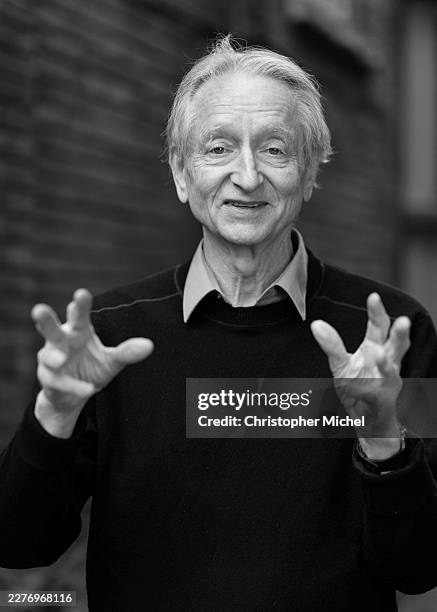
Geoffrey Hinton
 United Kingdom
computer scientist•artificial intelligence researcher•university teacher
Also known as: Godfather of AI
誕生日
December 6, 1947
星座
Sagittarius
出生地
Wimbledon, London, England
年齢
78歳
概要
ジェフリー・ヒントンは、英国系カナダ人のコンピューター科学者であり認知心理学者で、人工ニューラルネットワークと深層学習の基礎を築いた「AIの父」として広く知られています。長年にわたる研究の多くは、この分野が非常に不遇だった時代に行われ、現代の人工知能革命を支える中核技術の確立に貢献しました。ニューラルネットワークに対する長期間の懐疑論を乗り越えた彼の粘り強さは、分野全体にとって決定的なものでした。ヒントンの貢献は、今日の機械学習の中心にあります。彼は多層ネットワークの訓練に使われる誤差逆伝播法の普及に重要な役割を果たし、学生と共に行った画像認識の研究は画期的な成果を生み、深層学習が本格的に始まった瞬間と広く見なされ、その後の視覚、音声、言語分野の進歩の波を引き起こしました。その功績により、彼はノーベル賞の一部を授与され、この分野の影響力が顕著に認められました。注目すべき晩年の転機として、ヒントンはGoogleでの役職を辞し、高度なAIがもたらす危険性について自由に語るようになり、誤情報から実存的脅威に至るリスクを警告し、自らが生み出した技術に対して警鐘を鳴らす最も著名な声の一人となりました。思慮深く影響力のあるジェフリー・ヒントンは、現代人工知能の主要な建築家の一人と見なされています。
生い立ちと背景
ジェフリー・エベレスト・ヒントンは1947年12月6日、イギリス・ロンドンのウィンブルドンで生まれました。ブリストルのクリフトン・カレッジで教育を受け、1967年にケンブリッジ大学キングス・カレッジに入学。自然科学、美術史、哲学を経て実験心理学に落ち着き、1970年に学士号を取得しました。ケンブリッジ卒業後、1年間大工として働きました。1972年、当時英国で唯一の人工知能の大学院プログラムがあったエディンバラ大学でAIの博士号を開始。指導教官のクリストファー・ロングエット=ヒギンズは記号的AIを好みましたが、ヒントンはすでにニューラルネットワークに惹かれていました。1978年に博士号を取得。人間の脳への魅了が研究の原動力であり、学部生の頃から科学者がニューロンの学習や計算を真に理解していないことに気づき、そのプロセスを理解しようとキャリアを捧げました。その後、サセックス大学とカリフォルニア大学サンディエゴ校で博士研究員を務め、カーネギーメロン大学のコンピューター科学科で5年間教鞭を執りました。
キャリアの歩み
1980年代、ほとんどのAI研究者が記号的システムを追う中、ヒントンはニューラルネットワークを推進しました。1986年の重要な論文を共著し、多層ネットワークを訓練する誤差逆伝播法を普及させました。また、ボルツマンマシン、分散表現、時間遅延ニューラルネットワークにも重要な貢献をしました。1998年にはユニバーシティ・カレッジ・ロンドンにギャツビー計算神経科学ユニットを設立。2001年にトロント大学に教授として戻りました。転機は2012年:ヒントンと彼の学生アレックス・クリジェフスキー、イリヤ・サツケバーはAlexNetを開発し、ImageNet画像認識チャレンジで圧勝。この瞬間は深層学習のビッグバンと呼ばれています。2013年にGoogleにバイスプレジデント兼エンジニアリングフェローとして入社し、Brain Team Torontoを率いました。10年間在籍。2018年にはヨシュア・ベンジオ、ヤン・ルカンと共にACMチューリング賞を受賞。2024年にはジョン・ホップフィールドと共に、人工ニューラルネットワークによる機械学習を可能にする基礎的発見によりノーベル物理学賞を受賞しました。
キャリア年表
公的イメージとスタイル
ヒントンは「AIの父」として知られ、この肩書きには複雑な感情を抱いています。メディアは彼を、自らが警告する技術を構築するのを助けた創造者として、葛藤する人物として描くことがよくあります。2023年のGoogle離脱とその後のAIリスクに関する警告は世界中でニュースになりました。彼は普段、学術的な場でカジュアルな服装で見られ、思慮深く落ち着いた口調で話します。積極的なソーシャルメディア活動は行っておらず、認証済みのInstagramやFacebookアカウントはありません。研究者やテクノロジー愛好家の間で深い尊敬を集めています。彼の元学生には、ヤン・ルカン、ヨシュア・ベンジオ、イリヤ・サツケバーなど、AI分野で最も影響力のある人物が含まれます。2023年のTIME100 AIリストに選出され、The New York TimesやTIMEなどの主要メディアで取り上げられています。
名声とファンダム
Geoffrey Hinton commands a rare form of global attention that transcends the typical metrics of celebrity, driven by his pivotal role in shaping modern artificial intelligence and his subsequent warnings about its existential risks. His influence is quantified by authoritative placement within the iFANN Global Fame Rankings, which track the scope of public engagement across media, search, and consumption signals worldwide. Current data confirms he is the 9th most famous person in AI, a standing he has held steady through recent cycles of intense industry scrutiny. This ranking reflects not merely academic recognition but a sustained cultural dialogue regarding the future of machine learning. While his professional stature places him among the elite figures of his field, the composition of his audience differs sharply from entertainment icons. There is no documented fandom name for Geoffrey Hinton, nor are there organized fanbases engaging in campaigns or rituals dedicated to his person. The group that follows his work consists primarily of students, researchers, and industry professionals who study his contributions to deep learning, engaging with his ideas rather than his persona. Unlike pop stars whose legacies are built on viral moments and fan-driven chart pushes, Hinton's legacy remains rooted in intellectual authority and the sober reality of the technology he helped create.
興味深い事実と伝説
Before establishing himself as a leading figure in cognitive science, Geoffrey Hinton worked as a carpenter for a year following his graduation from Cambridge University. His middle name, Everest, honors his relative George Everest, the surveyor after whom the world's highest mountain is named. He is the great-great-grandson of George Boole, the logician whose algebraic systems form the bedrock of modern computing. His first cousin once removed, Joan Hinton, was one of only two women physicists to serve on the Manhattan Project. In February 2023, Hinton experienced what he described as a slow eureka moment, realizing that digital intelligence might already exceed human capabilities in specific domains. He has frequently warned that the cost to design a pathogen like COVID has dropped to approximately one hundred thousand dollars, highlighting the dangers of AI misuse. A defining moment in his recent career occurred in 2024 when he became the first computer scientist to receive the Nobel Prize in Physics for his work in machine learning. By August 2026, his reputation had evolved into that of a prophetic figure; during an appearance at the Ai4 conference, he delivered stark warnings about tech leaders Elon Musk and Mark Zuckerberg, earning the event's biggest applause. That same month, he engaged in high-profile debates with fellow pioneers Fei-Fei Li and Andrew Ng regarding regulation and job displacement, cementing his status as a central voice in the global conversation on AI safety.
注目の発言
“I have always been convinced that the only way to get artificial intelligence to work is to do the computation in a way similar to the human brain.”
“It now only costs about a hundred thousand dollars to design a pathogen like COVID, and so a cult with a million dollars could design ten of them and release them all at once.”
“The digital intelligence we've got now may be better than the brain already. It's just not scaled up quite as big.”
家族と私生活
注目の関係
恋愛関係と交際歴
2026年の給与・総資産
$10 Million
iFANN編集チームによる推定
iFANN currently estimates Geoffrey Hinton's net worth at $10 Million. Unlike many of his contemporaries in the technology sector, Hinton spent the majority of his career within academia rather than founding commercial enterprises. His financial accumulation stems primarily from his salary as a professor at the University of Toronto and his compensation package as Vice President and Engineering Fellow at Google between 2013 and 2023. Additional income sources include research grants and prize money awarded for his scientific contributions. The Turing Award provided a share of $1 million, distributed among three recipients, while the Nobel Prize carried approximately 11 million Swedish kronor, shared jointly with John Hopfield. He does not hold major business ventures or lucrative endorsement deals. His wealth has grown modestly over recent years, driven largely by these prestigious awards and his tenure at Google. He also receives honoraria for speaking engagements and has been recognized with other accolades such as the David E. Rumelhart Prize and the Gerhard Herzberg Canada Gold Medal.
受賞 (13)
ヒントンは科学とコンピューティングにおいて最高の栄誉のいくつかを受賞している。2024年にはジョン・J・ホップフィールドと共にノーベル物理学賞を共有した。2018年には、ヨシュア・ベンジオ、ヤン・ルカンと共にACMチューリング賞(コンピューティングのノーベル賞とも呼ばれる)を受賞した。2001年にはデイビッド・E・ルメルハート賞の初受賞者となった。その他の主要な賞には、王立協会のロイヤル・メダル、ゲルハルト・ヘルツバーグ・カナダ金メダル、キラム工学賞がある。
2024 · 物理学
Foundational discoveries enabling machine learning with artificial neural networks
2022 · 科学
Pioneering work on deep learning
キーワード
出典
クイック情報
- Full Name
- Geoffrey Everest Hinton
- 国籍
- British, Canadian
- Education
- BA in Experimental Psychology, Cambridge (1970); PhD in AI, Edinburgh (1978)
- Notable Awards
- Nobel Prize in Physics (2024), Turing Award (2018)
個人情報
- 本名
- Geoffrey Everest Hinton
- 学歴
- BA in Experimental Psychology from Cambridge University (1970); PhD in Artificial Intelligence from University of Edinburgh (1978)
よくある質問
ジェフリー・ヒントンは何歳ですか?
ジェフリー・ヒントンの総資産はいくらですか?
ジェフリー・ヒントンはGoogleを辞めたのですか?
ジェフリー・ヒントンは結婚していますか?
ジェフリー・ヒントンは何で最もよく知られているか?
ソーシャルメディア

コミュニティに参加
人のファンが話題に