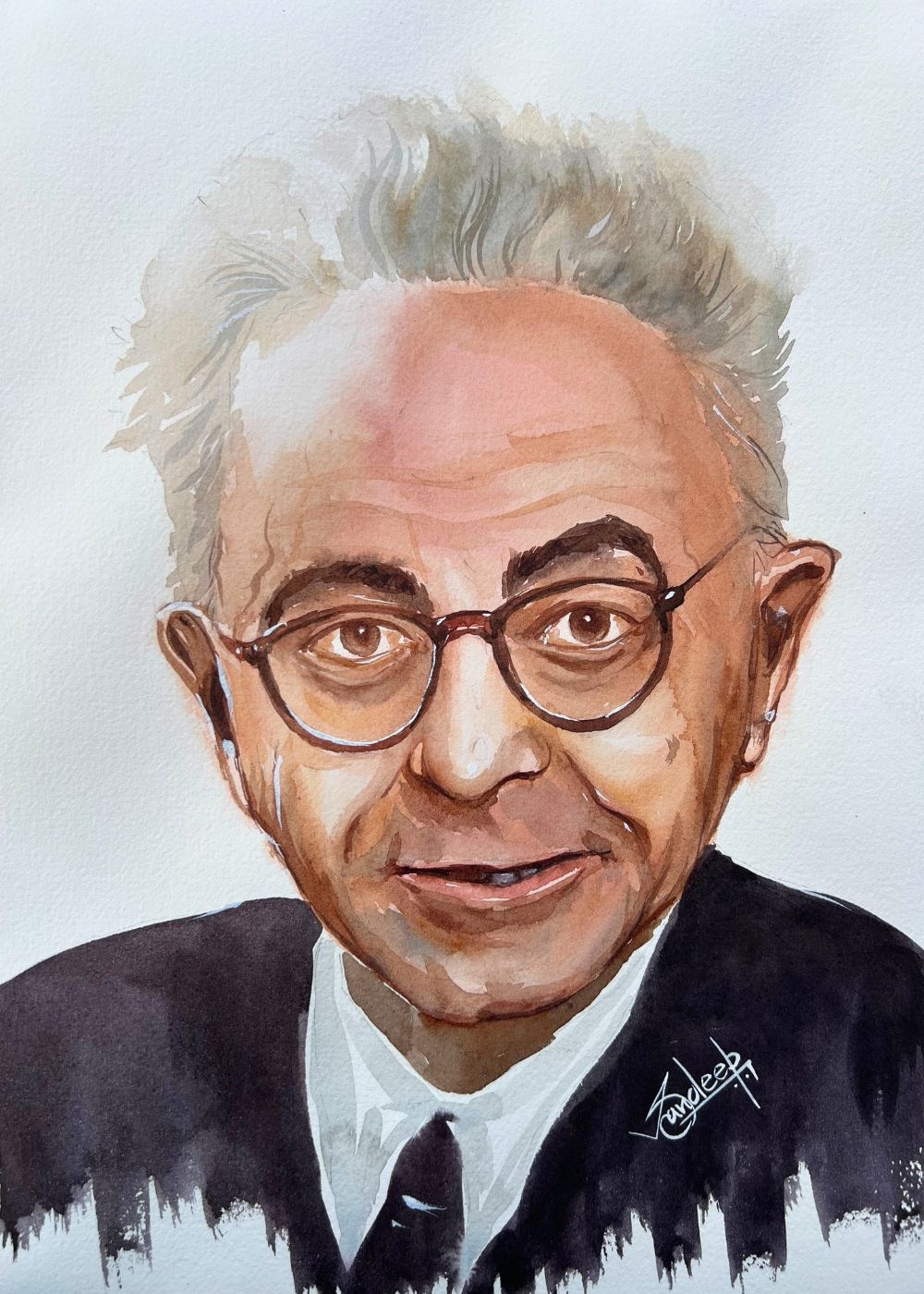
Richard Courant
 Poland
mathematician•university teacher•physicist
誕生日
January 8, 1888
星座
Capricorn
出生地
Lubliniec, Prussia (now Poland)
年齢
84歳で死去
概要
リチャード・クーラントは、応用数学に革命をもたらし、世界有数の研究機関を築き上げたドイツ系アメリカ人の数学者です。1888年1月8日、リュブリニエツ(当時プロイセン、現ポーランド)で生まれた彼は、ナチスから逃れてアメリカ合衆国に移住し、ニューヨーク大学に現在のクーラント数学科学研究所を設立しました。1972年1月27日に亡くなりました。
クーラントの研究は、実解析、数理物理学、変分法、偏微分方程式に及びました。彼はデビッド・ヒルベルトとの共著で画期的な教科書『Methods of Mathematical Physics』を、ハーバート・ロビンズとの共著で一般読者に高度なアイデアを開いた書籍『What is Mathematics?』を執筆しました。彼の教科書は、何世代もの科学者や数学者を教育してきました。
今日、クーラント研究所は応用数学とコンピューターサイエンスにおける世界有数のセンターとして、彼のビジョンが直接受け継がれています。クーラントの影響は、彼自身の業績だけでなく、彼が築いた機関や彼が指導した多くの学生を通して感じられます。
生い立ちと背景
リチャード・クーラントは、頻繁に引っ越しをするユダヤ人家庭で育ちました。父のジークムントは波乱に富んだ事業経歴を持ち、一家はグラッツやブレスラウに住んだ後、1905年にベルリンに移り住みました。少年時代、クーラントは学校で苦労し、算数さえ苦手でしたが、最終的にブレスラウのケーニヒ・ヴィルヘルム・ギムナジウムに通い、そこで数学の才能が開花しました。
彼はブレスラウ大学、チューリッヒ大学、そして最終的にはドイツ数学の中心地であるゲッティンゲン大学で学びました。そこで伝説的なデビッド・ヒルベルトのアシスタントとなり、1910年に博士号を取得しました。彼の初期の業績は、すでに数学の実用的な応用に対する強い関心を示しており、それは当時の多くの純粋数学者とは一線を画すものでした。
クーラントは第一次世界大戦に短期間従軍しましたが、負傷して除隊しました。戦後、彼はゲッティンゲンに戻り、キャリアを築き始めました。1920年代初頭のハイパーインフレの間、彼は驚くべき独創性を発揮し、実業家カール・スティルの支援を受けて数学研究所を維持しました。
キャリアの歩み
1920年から1933年まで、クーラントはゲッティンゲン大学の数学研究所を指導し、それを世界クラスのセンターへと発展させました。この期間中に、彼はデビッド・ヒルベルトと共著で『Methods of Mathematical Physics』(1924年初版)を執筆し、このテキストは現在でもこの分野の礎となっています。また、後に有限要素法となるものの開発に着手し、1922年に最初のバージョンを発表しました。
ドイツ系ユダヤ人の難民として、クーラントは1930年代にアメリカ合衆国へ移住しました。1946年、彼はニューヨーク大学に数学・力学研究所を設立し、後にクーラント数学科学研究所となりました。彼の指導の下、研究所は優秀な数学者を集め、波の伝播、爆発、その他の応用問題の研究のために主要な政府資金を確保し、数学におけるNYUの地位を高めました。
クーラントは1958年に引退しましたが、活動を続けました。彼の著書『What is Mathematics?』(1941年)は古典となり、数十万部を売り上げ、数え切れないほどの読者にインスピレーションを与えました。彼が先駆者となった有限要素法は、現在、工学と物理学における偏微分方程式の解法に不可欠となっています。
キャリア年表
公的イメージとスタイル
リチャード・クーラントは、厳密でありながら実用的で、応用数学を擁護し、強力な機関を築いた学者として記憶されています。彼の公的なイメージは、才能を引きつけ、資金を確保し、協力的な環境を作り出すことができる、輝かしい組織者であり指導者というものです。彼は、特に『What is Mathematics?』に見られるような、明確で分かりやすい文章スタイルで知られており、それが彼を幅広い一般読者に到達した数少ない数学者の一人にしました。
数学界では、クーラントは彼の教科書とクーラント研究所の設立者として尊敬されています。理論を現実世界の問題と結びつけることへの彼のこだわりは、応用数学の現代的なアイデンティティを形成するのに役立ちました。彼を中心としたファンダム名やファン文化はありませんが、彼の名前は研究所と彼が訓練した多くの数学者を通して生き続けています。
名声とファンダム (iFAMOUS Rankings)
Richard Courant commanded a global stage of profound influence, yet his reach remained strictly within the corridors of academia rather than the roar of pop culture. The iFANN Global Fame Engine has evaluated this towering figure of 20th-century science, but he does not currently hold a placement in the published rankings, including the Global Top 1,000 or any Top-100 scope list. His legacy is defined by the quiet power of institutional building and rigorous scholarship, not by viral metrics or chart positions. While he shaped the very language of applied mathematics through works like *Methods of Mathematical Physics* and *What is Mathematics?*, no formal fanbase emerged to rally behind his name. There is no documented fandom name associated with Courant; the audience that revered him were students, colleagues, and scholars who encountered his ideas through textbooks and lectures rather than celebrity worship. Unlike modern icons who generate organized campaigns or birthday billboards, Courant's interactions were professional and intellectual. His followers sought understanding, not autographs, and the community that grew around the Courant Institute at NYU operated as a center for discovery rather than a cult of personality. The absence of a named fandom reflects the nature of his fame: it was earned through the enduring utility of his equations and the strength of his mentorship, leaving no room for the performative adoration that defines contemporary stardom. Even decades after his death in 1972, the reverence for Courant remains academic, focused on the mathematical structures he helped codify rather than the man himself.
興味深い事実と伝説
Richard Courant's cousin was Edith Stein, a student and assistant to philosopher Edmund Husserl. Stein became a Catholic nun, was murdered at Auschwitz, and was later canonized as a saint by the Roman Catholic Church. He was wounded and discharged from the German army shortly after enlisting in World War I. Despite his later fame as a mathematician, Courant struggled with arithmetic as a child. Courant believed that empirical evidence could never establish mathematical existence, only a rigorous proof could ensure that a mathematical description of a physical phenomenon was meaningful. The Courant Institute building at NYU, dedicated in 1965, was the first in the United States built specifically for mathematical research. A historical account notes his role in building the mathematical sciences at NYU, sometimes referred to in academic history as the "Courant Hilton" regarding the institution's growth. As of November 2025, NYU established a new school named in his honor: the "Courant Institute School of Mathematics, Computing, and Data Science," signaling the continued high regard for his contributions to science and technology.
注目の発言
“Empirical evidence can never establish mathematical existence nor can the mathematician's demand for existence be dismissed by the physicist as useless rigor. Only a mathematical existence proof can ensure that the mathematical description of a physical phenomenon is meaningful.”
家族と私生活
注目の関係
Courant worked closely with David Hilbert at Göttingen, co-authoring a seminal textbook. He collaborated with Herbert Robbins on What is Mathematics?. His father-in-law was mathematician Carl Runge, and his sister-in-law was applied mathematician Iris Runge. His cousin Edith Stein became a Catholic saint. Warren Weaver, head of the OSRD's Applied Mathematics Panel, was a colleague and supporter.
恋愛関係と交際歴
Richard Courant married twice. His first wife was Nelly Neumann, a fellow student from Breslau, whom he married in 1912. The marriage ended in divorce in 1916. Nelly Neumann was later murdered by the Nazis in 1942. In 1919, Courant married Nerina (Nina) Runge, the daughter of mathematician Carl Runge. They remained together until Courant's death in 1972.
- 既婚Nelly Neumann1912 - 1916Married in 1912, divorced in 1916. Nelly was later murdered by the Nazis in 1942.
- 既婚Nerina (Nina) Runge1919 - 1972Daughter of mathematician Carl Runge. They were married until Courant's death.
死去とその後
死没
January 27, 1972 (84歳没)
死没地
New York City, New York, USA
死因
自然死
Richard Courant, the renowned German-American mathematician and founder of NYU's Courant Institute of Mathematical Sciences, died on Thursday, January 27, 1972, at the age of 84. He was born on January 8, 1888. According to a contemporary report in The New York Times, he passed away Thursday afternoon at New York University Hospital. While the exact time is not specified beyond afternoon, the location remains confirmed as the hospital associated with his institution. The obituary notes simply state that he died at the hospital without citing a specific disease or condition.
Public reaction to his death was marked by tributes from the academic community recognizing him as one of the greatest organizers of mathematical research and teaching of the twentieth century. Tributes focused on his intellectual legacy, particularly his co-authorship of the influential text with David Hilbert and his founding of the Courant Institute. Details regarding his funeral or memorial service are not explicitly provided in the search results, including the date, location, or list of attendees. It is noted that he was buried, but the specific cemetery is not identified in the provided text.
The institution he built served as the primary vessel for his posthumous honor, absorbing his vision into its very structure. This institutional evolution serves as a primary form of posthumous honor alongside the enduring impact of his works such as What Is Mathematics?. The Courant Institute recently underwent a significant expansion in November 2025, becoming the Courant Institute School of Mathematics, Computing, and Data Science to unify programs across computer science and data science. His legacy continues through this expanded entity which stands as a reflection of his contributions to the field.
総資産(遺産評価額)
As Richard Courant died in 1972, his estate's current value is not publicly documented. His primary financial legacy is the Courant Institute of Mathematical Sciences at NYU, which continues to thrive. During his lifetime, Courant's income came from his academic salary, book royalties (particularly from What is Mathematics? and Methods of Mathematical Physics), and government research grants. His estate likely includes residual royalties from his textbooks, which remain in print and are used worldwide. However, no specific estate value or posthumous earnings figures are available in public sources.
受賞と栄誉
View 2 records, honours and achievements代表作
Methods of Mathematical Physics
1924 · 共著者
What is Mathematics?
1941 · 共著者
Courant Institute of Mathematical Sciences
1946 · 創設者
Finite element method
1943 · パイオニア
キーワード
出典
クイック情報
- 職業
- mathematician, university teacher, physicist
- 生年月日
- +1888-01-08
- 出生地
- Lubliniec
- 死没
- +1972-01-27
- 死没地
- New Rochelle
- 性別
- 男性
- 星座
- Capricorn
個人情報
- 本名
- Richard Courant
- 配偶者
- Nerina (Nina) Runge
- 学歴
- University of Göttingen (PhD, 1910)
よくある質問
Who was Richard Courant?
What is Richard Courant famous for?
Where was Richard Courant born?
When did Richard Courant die?
What is the Courant Institute?
コミュニティに参加
人のファンが話題に