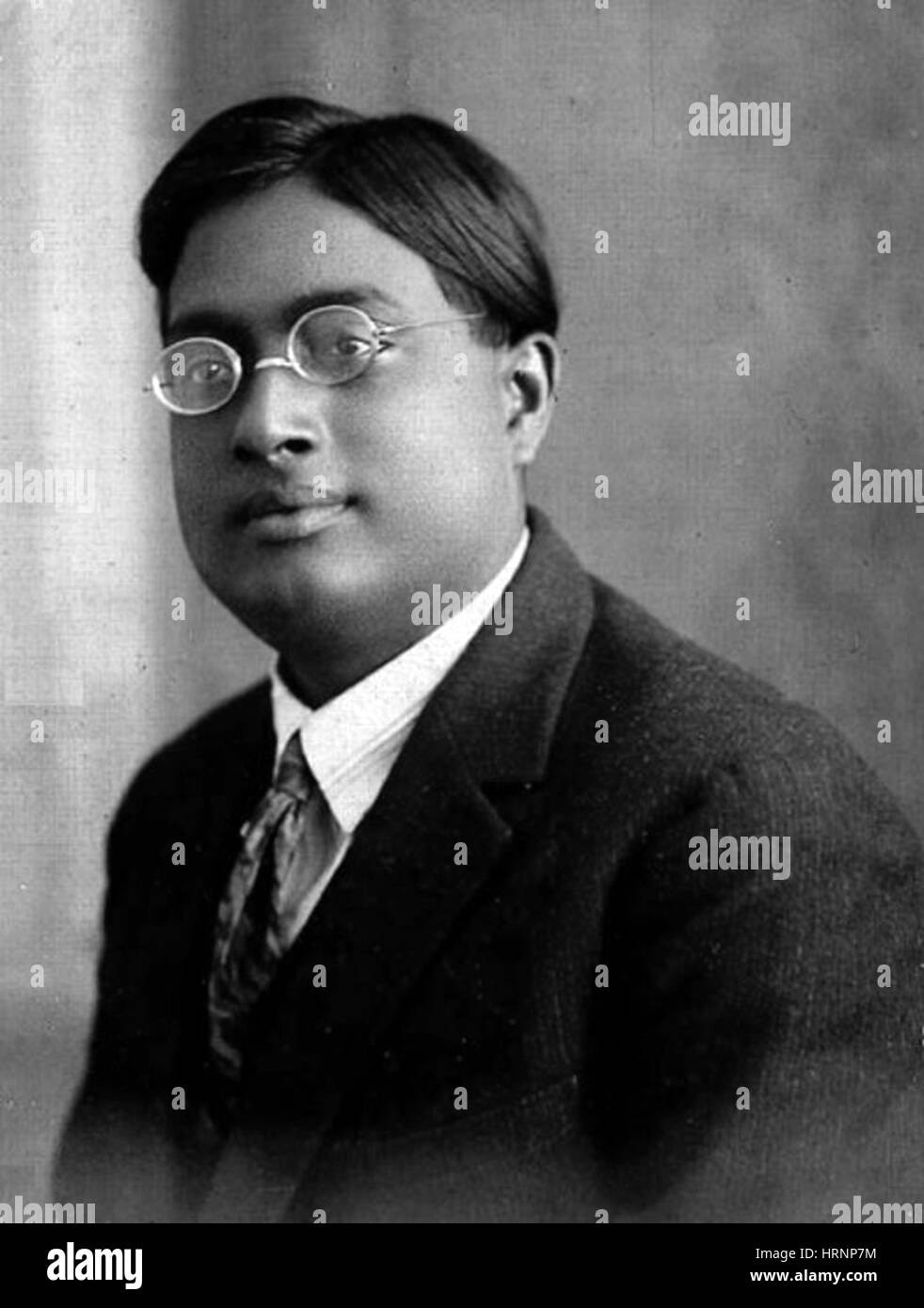
Satyendra Nath Bose
 India
India誕生日
January 1, 1894
星座
Capricorn
出生地
Kolkata, India
年齢
80歳で死去
概要
Satyendra Nath Bose was an Indian theoretical physicist and mathematician whose work in the early 1920s reshaped quantum mechanics. He developed Bose-Einstein statistics, a framework that describes how particles like photons behave, and laid the groundwork for the Bose-Einstein condensate, a state of matter observed at near-absolute-zero temperatures. Physicist Paul Dirac named the class of particles that follow these rules bosons in his honor.
Bose was elected a Fellow of the Royal Society and received the Padma Vibhushan, India's second-highest civilian award, in 1954. A polymath with interests spanning physics, mathematics, chemistry, biology, philosophy, and music, he also served on national research committees after India's independence. He died on February 4, 1974, in Kolkata, leaving a legacy that continues to influence modern physics.
生い立ちと背景
サティエンドラ・ナート・ボースは1894年1月1日、カルカッタで7人兄弟の長男として生まれました。父スレンドラナート・ボースは東インド鉄道の会計士として働いた後、自身の化学・製薬会社を興しました。母アモディニ・デヴィは、英語教育を重視する中流家庭を切り盛りしました。
ボースの才能は早くから現れました。カルカッタのヒンドゥー・スクールでは、数学教師のウペンドララル・バクシが彼の天才性を認めました。ボースは数学の試験で複数の解法を用いて問題を解き、100点満点中110点を取ったこともあります。1909年の入学試験では全受験者中5位で合格しました。カルカッタのプレジデンシー・カレッジで1913年に混合数学の理学士号を首席で取得。カルカッタ大学に進学し、1915年の混合数学修士課程の成績は長年にわたり記録を打ち立てました。
修士課程修了後、ボースは1916年にカルカッタ大学で研究を始め、相対性理論に焦点を当てました。1921年からダッカ大学で教鞭を執り、そこで画期的な発見をすることになります。
キャリアの歩み
1924年、ダッカ大学の講師だったボースは、プランクの法則と光量子仮説と題する論文を執筆しました。彼は同一粒子の状態を数える新しい方法を用いて、粒子を区別できないものとして扱い、プランクの量子放射則を導出しました。発表できずにいたところ、アルベルト・アインシュタインに論文を送り、アインシュタインはその重要性を認識し、ドイツ語に翻訳して雑誌Zeitschrift für Physikに投稿しました。この研究がボース=アインシュタイン統計の基礎となりました。
アインシュタインはボースのアイデアを物質に拡張し、ボース=アインシュタイン凝縮を予測しました。この物質の状態は1995年に実験的に確認されました。1926年、ボースはダッカ大学の物理学部長に就任。1945年にカルカッタ大学に戻り、1956年に退職するまで教鞭と研究を続けました。また、ベンガル語で相対性理論の大学院講義を行い、現地語での科学教育を推進しました。
インド独立後、ボースは様々な国家研究開発委員会に参加。1958年にはインド議会上院であるラージヤ・サバーに指名されました。
キャリア年表
公的イメージとスタイル
名声とファンダム
Satyendra Nath Bose commands a global audience defined by academic reverence rather than popular celebrity, with his name recognized primarily within the scientific community and among history enthusiasts. The iFANN Global Fame Engine evaluated this figure in August 2026 and determined that Satyendra Nath Bose is currently unranked on the Global Top 1,000 list or any scope-specific top-100 charts, meaning no placement number applies to his current standing. While he remains a towering historical figure, he does not hold a specific ordinal position in the published rankings at this time. His legacy is sustained through institutional memory and the enduring study of quantum mechanics rather than modern fan metrics. Regarding his audience, there is no documented fandom name; the group of admirers consists of physicists, mathematicians, and students who engage with his work through academic channels rather than as an organized fanbase with a specific moniker. No rituals, campaigns, or social media movements are associated with him, reflecting his status as a scholar from a pre-celebrity era whose influence is measured in citations and scientific breakthroughs rather than public adulation.
興味深い事実と伝説
Satyendra Nath Bose was a polymath with deep interests in chemistry, biology, mineralogy, philosophy, arts, literature, and music. He could recite poetry in multiple languages and played the violin. He was known for his humility and often said he did not consider himself a genius. Rabindranath Tagore dedicated his only science book, Visva-Parichay, to Bose in 1937. Bose also campaigned for Hindi to replace English as the language of science in India. A central pillar of his legend is the incident where he sent a paper on quantum statistics to Albert Einstein after facing rejection from European journals. Einstein recognized the brilliance of the work, translated it into German himself, and submitted it to Zeitschrift für Physik, an event that led to particles following these rules being named bosons. Another poignant story from his life involves his reaction to Einstein's death; accounts state that Bose was so shattered by grief that he tore up an unpublished research paper. This anecdote highlights the profound personal bond between the two scientists and serves as a narrative illustrating Bose's character and loyalty.
注目の発言
“I do not consider myself a genius. I only followed my curiosity.”
“Science should be taught in the language of the people.”
“The joy of discovery is the greatest reward.”
“Einstein's recognition of my work gave me the confidence to continue.”
“I never aimed for fame; I aimed for understanding.”
家族と私生活
注目の関係
恋愛関係と交際歴
サティエンドラ・ナート・ボースは1910年代初頭、伝統的な儀式でウシャバラ・ボース(ウシャバティ・ゴーシュとしても知られる)と結婚した。結婚生活は安定した支え合いの関係だった。ウシャバラは家事を管理し、9人の子供を育てながら、ボースの学術的キャリアを支えた。彼女は献身的な妻で、彼の科学的研究を励ましたと評されている。ボースは1974年に亡くなるまで彼女と結婚生活を続けた。他の恋愛関係の記録はない。
- 既婚Ushabala Bose1914 - 1974伝統的なベンガル式結婚。彼女は彼のキャリアを支え、9人の子供を育てた。
死去とその後
死没
February 4, 1974 (80歳没)
死没地
Calcutta, West Bengal, India
死因
老衰
Satyendra Nath Bose spent his final years in Calcutta, maintaining his academic interests and family life until the natural decline of advanced age took its toll. He passed away on February 4, 1974, within the city that had been his home for decades, marking the end of a life dedicated to theoretical physics and mathematics. The circumstances surrounding his death were reported as peaceful and natural, with no specific acute illness, accident, or foul play documented by authorities or biographical sources. His passing occurred without a public hospitalization immediately preceding the event, suggesting he died in a private setting consistent with the privacy norms for senior academics in India during that era.
The scientific community and government officials responded to his death with profound tributes rather than legal inquiries or investigations. While the funeral was conducted as a private affair following Hindu cremation rites, the legacy of the physicist was cemented through institutional memorials and continued recognition by the state. The Indian government established the Bose Institute in his honor, and his contributions remain celebrated annually on National Science Day. In recent decades, his name has appeared in educational materials and news regarding quantum physics breakthroughs, including references to the creation of Bose-Einstein condensates in the mid-2020s.
Posthumous honors included the naming of the subatomic particle boson after him and the enduring status of Bose-Einstein statistics as a foundational theory. A new book by his student Partha Ghose released around May 2024 highlighted their relationship and Bose's grief over Einstein's death, adding to the literary legacy. No major commercial films were produced solely about his death, though his name frequently appears in discussions of quantum mechanics.
総資産(遺産評価額)
$1 Million
iFANN編集チームによる推定
As a theoretical physicist and academic, Satyendra Nath Bose did not accumulate significant personal wealth. Per iFANN's editorial analysis, his net worth at the time of his death in 1974 is estimated at $1 Million in 2026 terms, primarily consisting of his academic salary, modest savings, and a small pension. He lived a simple life, dedicating his resources to his family and research. Posthumously, his legacy has not generated substantial estate income, though his name is honored through institutions like the S. N. Bose National Centre for Basic Sciences.
受賞 (2)
サティエンドラ・ナート・ボースは1954年、科学への貢献によりインドで2番目に高い民間人賞であるパドマ・ヴィブーシャンを受賞した。1958年には科学者にとって最高の栄誉の一つである王立協会フェローに選出された。また、カルカッタ大学やダッカ大学を含むいくつかの大学から名誉博士号を授与された。
1954 · 民間人賞
Science
1958 · 選出
Science
代表作
Bose–Einstein statistics
1924 · 開発者
Bose–Einstein condensate
1925 · Co-theorist
Planck's Law derivation
1924 · 作家
Boson particle naming
1925 · Namesake
キーワード
出典
クイック情報
- 職業
- physicist, mathematician
- 生年月日
- January 1, 1894
- 出生地
- Kolkata, India
- 死没
- February 4, 1974
- 死没地
- Kolkata, India
- 性別
- 男性
- 配偶者
- Ushabala Bose
- 星座
- Capricorn
個人情報
- 本名
- Satyendra Nath Bose
- 配偶者
- Ushabala Bose
- 子ども
- 9
- 学歴
- B.Sc. in mixed mathematics, Presidency College, Calcutta (1913); M.Sc. in mixed mathematics, University of Calcutta (1915)
よくある質問
サティエンドラ・ナート・ボースとは誰ですか?
サティエンドラ・ナート・ボースは何で有名ですか?
2026年のサティエンドラ・ナート・ボースの総資産は?
サティエンドラ・ナート・ボースはノーベル賞を受賞しましたか?
サティエンドラ・ナート・ボースはどのような賞を受賞しましたか?
コミュニティに参加
人のファンが話題に