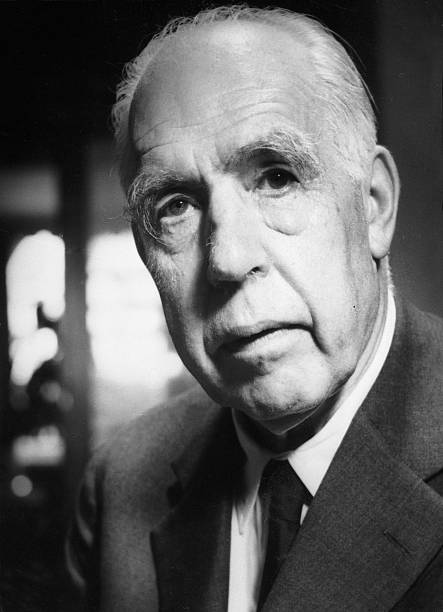
Niels Bohr
 Denmark
university teacher•nuclear physicist•philosopher of science
誕生日
October 7, 1885
星座
Libra
出生地
Copenhagen, Denmark
年齢
77歳で死去
身長
5 ft 10 in (178 cm)
概要
ニールス・ボーアは、原子に対する理解を一新したデンマークの理論物理学者であり科学哲学者です。彼は、電子が離散的なエネルギー準位で原子核を周回するというボーアの原子模型で最も有名です。原子構造と量子論に関する先駆的な業績により、1922年にノーベル物理学賞を受賞しました。また、相補性の原理を導入し、物理学と哲学の両方に影響を与えました。コペンハーゲン大学に理論物理学研究所(現在のニールス・ボーア研究所)を設立し、一世代の物理学者を指導しました。彼は元素ハフニウムを予言し、合成元素ボーリウムは彼に敬意を表して命名されました。第二次世界大戦後、ボーアは核兵器の国際管理を提唱し、CERNの設立に貢献しました。彼の遺産は今も世界中の物理学者や哲学者に影響を与え続けています。
生い立ちと背景
ニールス・ヘンリック・ダヴィッド・ボーアは、1885年10月7日、デンマークのコペンハーゲンで、知的探求心と科学的議論にあふれた家庭に生まれました。父のクリスチャン・ボーアはコペンハーゲン大学の著名な生理学教授であり、母のエレン・アドラー・ボーアはユダヤ系の裕福な銀行家の家系の出身でした。この活気ある家庭環境により、幼いニールスは早い時期から高度な科学的議論に触れ、しばしば父に同行してデンマーク王立アカデミーの会合に参加しました。彼はガンメルホルム・ラテン語学校に通い、物理学と数学への天性の適性がすぐに明らかになりました。これらの厳格な科目で優秀な成績を収め、分析的思考の初期の才能を示しましたが、エッセイ執筆はより困難な課題だったと伝えられています。
1903年、ボーアはコペンハーゲン大学に入学し、急速かつ輝かしい学術的キャリアを歩み始めました。1907年に学士号、1909年に修士号を取得し、1911年に博士号を修了しました。金属の複雑な電子理論を探求した博士論文は、学界で画期的と認められました。しかし、密度の高いデンマーク語で書かれていたため、国際的な舞台で即座に広く注目されることはなく、革新的な洞察の認知が遅れました。
ボーアの将来の貢献にとって重要な時期は、博士号取得後まもなく始まりました。1911年、彼はイギリスのケンブリッジに渡り、電子の発見者であるJ.J. トムソンの指導の下、有名なキャヴェンディッシュ研究所で研究を深めようとしました。しかし、この最初の協力はボーアにとって実り多いものではありませんでした。挫けずに、1912年にマンチェスターに移り、アーネスト・ラザフォードの下で働くという決定的な行動に出ました。ラザフォードの革命的な原子核模型(小さく密度の高い原子核を電子が周回するというもの)の下で、ボーアは自身の革命的なアイデアの肥沃な土壌を見出しました。ラザフォードの原子模型は、ボーアが原子構造と量子力学に関する画期的な理論を構築するための基本的な枠組みとなりました。
キャリアの歩み
1913年、ボーアは原子構造に関する画期的な三部作の論文を発表し、電子が量子化されたエネルギー準位で原子核を周回することを提唱しました。このボーア模型は水素のスペクトルをうまく説明し、即座に国際的な認知を得ました。1916年、コペンハーゲン大学の理論物理学教授に任命されました。4年後、理論物理学研究所を設立し、世界中から若い物理学者を集めて量子力学の世界的な拠点となりました。
ボーアは1922年、37歳でノーベル物理学賞を受賞しました。1927年、コモ会議で相補性の原理を導入し、これは量子力学のコペンハーゲン解釈の基礎となりました。1930年代を通じて、原子核の液滴模型を発展させ、後に核分裂の説明に役立ちました。1943年、ナチス占領下のデンマークから脱出した後、ボーアはロスアラモスのマンハッタン計画に参加しました。原子爆弾の開発に携わりましたが、戦後は一貫して核兵器の国際管理を主張しました。1954年のCERN設立に貢献し、1957年には北欧理論物理学研究所の初代所長に就任しました。
キャリア年表
公的イメージとスタイル
ボーアは、パイプ、思慮深い態度、そして穏やかでソクラテス的な教育スタイルで知られていました。柔らかく慎重な声で話し、学生に対しては限りなく忍耐強いと評されました。メディアでの描写では、彼は一貫して量子力学の賢明な父親的存在、外交的で、深く哲学的で、人道主義者として描かれています。アルバート・アインシュタインとの量子力学に関する議論は伝説的で、「神はサイコロを振らない」というアインシュタインの言葉は、ボーアの確率的解釈に向けられたものです。ボーアのファンダムは主に学術的で、物理学者、科学史家、哲学愛好家から構成されています。ニールス・ボーア研究所での年次ニールス・ボーア講演会は主要なイベントであり、ボーア=アインシュタイン論争は今でもシンポジウムや公開講演の人気テーマです。
名声とファンダム
Niels Bohr commands a legacy defined not by the chaotic adoration of pop culture, but by the enduring reverence of the scientific community and historians. While he lacks an organized fanbase with official monikers or ritualistic campaigns, his intellectual influence persists through academic institutions like the Niels Bohr Institute and the global study of quantum mechanics. The stories that surround him are those of verified historical milestones rather than viral moments; the debates with Albert Einstein remain the central pillar of his mythology, recently reignited by experimental confirmations in 2025 and 2026 that validated his probabilistic interpretations decades after his death. His status as a figure of immense historical weight is quantified by the iFANN Global Fame Rankings. Within this framework, he holds a steady position as the 10th most famous person from Denmark, a ranking anchored in his national significance. Furthermore, his standing within the broader historical landscape places him as the 23rd most famous person in Classical studies, reflecting the timeless nature of his contributions to physics and philosophy. These placements underscore his transition from a contemporary scientist to a foundational figure in human history.
興味深い事実と伝説
Niels Bohr's first scientific paper on water jets secured the Royal Danish Academy's gold medal in 1907. During his dramatic escape from occupied Denmark in 1943, he nearly perished when the oxygen system failed on the Mosquito bomber transporting him to Britain; he passed out and survived only because the pilot descended to a lower altitude. He designed his own coat of arms featuring the yin-yang symbol accompanied by the motto "Contraria sunt complementa" (Opposites are complementary). The Danish government granted him an honorary residence at Carlsberg Mansion, a privilege traditionally reserved for the nation's most distinguished citizens. Beyond these facts, the scientific community often recounts the legendary series of debates between Bohr and Albert Einstein from 1927 to 1935, where Einstein famously declared that God does not play dice against Bohr's Copenhagen Interpretation. This rivalry was so pivotal that recent experiments in late 2025 and early 2026 by Chinese scientists have been cited as finally validating Bohr's position over Einstein's objections. Another recurring anecdote involves his brother Harald Bohr, an Olympic gold medalist in football, highlighting the athletic prowess of the Bohr family alongside their scientific genius.
注目の発言
“An expert is a person who has made all the mistakes that can be made in a very narrow field.”
“The opposite of a correct statement is a false statement. But the opposite of a profound truth may well be another profound truth.”
“We are all agreed that your theory is crazy. The question that divides us is whether it is crazy enough to have a chance of being correct.”
“Never express yourself more clearly than you are able to think.”
“Everything we call real is made of things that cannot be regarded as real.”
家族と私生活
ボーアは、コペンハーゲン大学の生理学教授クリスチャン・ボーアと、ユダヤ系の裕福な銀行家の家系出身のエレン・アドラー・ボーアの間に生まれました。弟に一人、著名な数学者でオリンピックサッカー選手となったハラルド・ボーアがいました。ボーアは1912年8月1日にマルグレーテ・ノールルンドと結婚しました。6人の息子をもうけました:クリスチャン(18歳でボート事故で死去)、ハラルド(幼児期に死去)、ハンス(医師)、エリック(化学技術者)、オーゲ(ノーベル物理学賞受賞者)、アーネスト(弁護士)。一家は1932年からコペンハーゲンのカールスバーグ・マンションの名誉邸宅に住みました。ボーアの家庭には妻と息子たちが含まれ、彼は多忙な仕事にもかかわらず献身的な父親として知られていました。
注目の関係
恋愛関係と交際歴
ボーアは1912年8月1日、民事婚でマルグレーテ・ノールルンと結婚した。彼女は数学者ニールス・エリク・ノールルンの妹であった。マルグレーテはボーアの生涯の伴侶であり、相談役であり、知的パートナーでもあり、原稿をタイプし、会議に同行し、家庭を管理した。2人の間には6人の息子が生まれた:クリスチャン(18歳でボート事故により死去)、ハラルド(幼児期に死去)、ハンス、エリク、オーゲ(1975年にノーベル物理学賞受賞)、アーネスト。結婚生活はボーアが1962年に亡くなるまでの50年間に及んだ。公に文書化された他の恋愛関係は信頼できる形で報告されていない。彼の個人的な書簡や伝記は一貫して、献身的で一夫一婦制の結婚生活を記述している。
- 既婚Margrethe Nørlund1912 - 1962生涯の伴侶であり知的パートナー。原稿をタイプし、家庭を管理した。
死去とその後
死没
November 18, 1962 (77歳没)
死没地
Copenhagen, Denmark
死因
Heart failure due to coronary artery disease
Tributes poured in from world leaders and the global scientific community following the passing of Niels Bohr, with King Frederik IX presiding over a state funeral that drew high-ranking Danish officials and leading physicists from around the world. Albert Einstein, who had died just three months prior, was among the prominent scientists whose loss was noted alongside Bohr's, while Werner Heisenberg and Enrico Fermi issued formal statements honoring his contributions to quantum mechanics and atomic theory. The scientific community observed moments of silence and saw an immediate surge in academic citations and reprints of his work, reflecting the profound impact of his death on international physics. Bohr passed away peacefully in his sleep at his home at Blegdamsvej 17 in Copenhagen on November 18, 1962, at the age of 77.
His final days followed a gradual decline in health after a heart attack earlier that year, culminating in his last public appearance in late October when he delivered a speech at the opening of the new Niels Bohr Institute building despite his deteriorating condition. The official cause of death was determined to be heart failure resulting from long-standing coronary artery disease by his personal physician, who attended him during his final days. The funeral service took place five days later on November 23, 1962, at the Church of Our Lady in Copenhagen before burial at the Assistens Cemetery in the Nørrebro district. Eulogies emphasized his role as a mentor to the generation of physicists who shaped modern physics, featuring traditional church hymns appropriate for a state funeral of his stature.
Posthumous honors included the establishment of the Niels Bohr Medal by the International Union of Pure and Applied Physics in 1963 and the naming of element Bohrium in his honor by the IUPAC in 1997. His legacy remains anchored by the continued operation of the Niels Bohr Institute as a premier research center and the preservation of his papers and correspondence within the Niels Bohr Library & Archives and the Royal Danish Academy of Sciences. The family estate was handled privately, ensuring the maintenance of his intellectual property rights and archival holdings managed by the institute.
総資産(遺産評価額)
$5 Million
iFANN編集チームによる推定
Niels Bohr died in 1962, and per iFANN's editorial analysis, his estate is valued at approximately $5 million as of 2026. This figure reflects intellectual property rights, book royalties, and archival holdings managed by the Bohr family through the Niels Bohr Archive and the Niels Bohr Institute. Bohr lived modestly as a university professor and Nobel laureate. He donated much of his Nobel Prize money to scientific causes and refugee relief. His collected works, published in multiple volumes, continue to generate royalties. The Niels Bohr Institute receives ongoing funding and donations in his honor. The estate's primary revenue sources include licensing of his image and name for educational materials, research grants to the Niels Bohr Archive, and steady book royalties from his philosophical and scientific writings.
受賞 (8)
ボーアは1922年、原子構造の研究によりノーベル物理学賞を受賞しました。また、ヒューズ・メダル(1921年)、マテウッチ・メダル(1923年)、フランクリン・メダル(1926年)、マックス・プランク・メダル(1930年)、コプリ・メダル(1938年)、そして初のAtoms for Peace Award(1957年)も受賞しています。1947年にはデンマーク最高の王立勲章であるエレファント勲章を授与されました。
1957 · 平和
1947 · 王立勲章
代表作
Bohr Model of the Atom
1913 · Developer
Principle of Complementarity
1927 · Formulator
Copenhagen Interpretation
1927 · 共同創業者
Liquid-Drop Model of the Nucleus
1936 · Developer
Manhattan Project
1943 · 貢献者
キーワード
出典
クイック情報
個人情報
- 本名
- Niels Henrik David Bohr
- 身長
- 5 ft 10 in (178 cm)
- 配偶者
- Margrethe Bohr
- 子ども
- 6 sons: Christian, Harald, Hans, Erik, Aage, Ernest
- 学歴
- University of Copenhagen (B.A. 1907, M.A. 1909, Ph.D. 1911)
よくある質問
ニールス・ボーアは何で有名ですか?
ニールス・ボーアは原子爆弾の開発に関わったのですか?
ニールス・ボーアは何歳で亡くなりましたか?
ニールス・ボーアには子供がいましたか?
ニールス・ボーアのIQはいくつでしたか?
似た人物
コミュニティに参加
人のファンが話題に